
GlobalSat BD-100K RTK GNSS
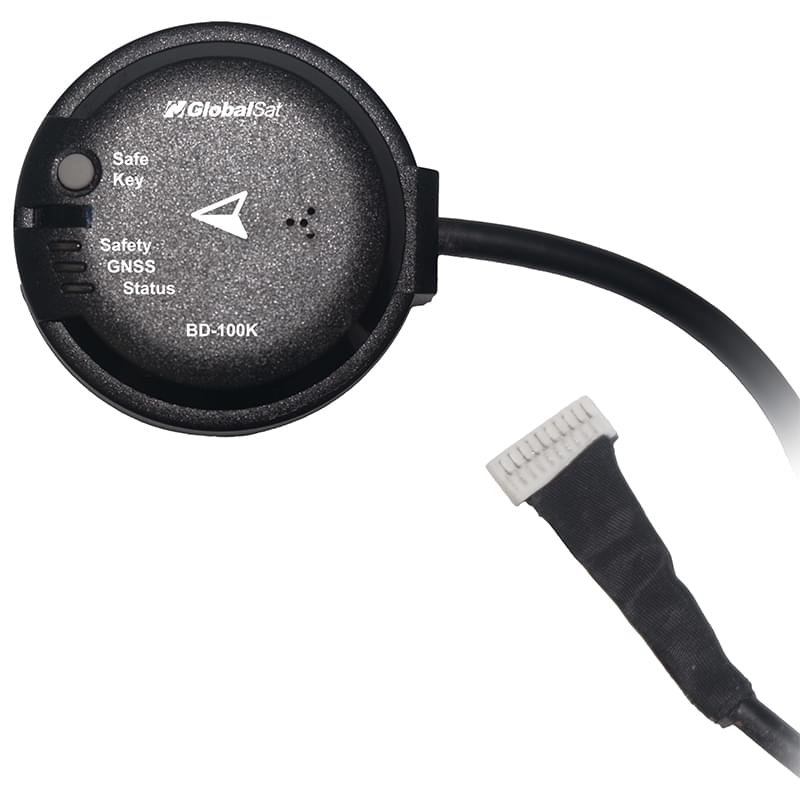
The GlobalSat BD-100K is an L1/L5 dual-band RTK GNSS receiver that connects to the flight controller using UART. It is based on the AIROHA AG3335A and includes a compass, barometer, safety switch, buzzer and LED. Powered by an advanced multi-frequency GNSS engine, the BD-100K delivers centimetre-level positioning, fast RTK convergence, and robust tracking in challenging environments such as urban canyons or dense foliage. GlobalSat has tested this receiver on PX4 v1.17.0 with a Holybro Pixhawk 6C.
Typical applications include:
- Drone and autopilot RTK centimetre-level positioning
- High-precision flight-control positioning
- Robotics and autonomous outdoor systems
Specifications
- Receiver: AIROHA AG3335A
- Constellations: Multi-constellation, multi-frequency all-in-view tracking; SBAS ranging (WAAS, EGNOS, MSAS and GAGAN)
- Bands: L1 + L5, with RTK centimetre-level positioning
- RTK: Fast RTK fix and strong anti-multipath design
- Protocol: NMEA 0183 V3.01 / V4.1 (GGA, GSA, GSV, RMC, VTG, GLL, ZDA, GRS, GST); AIROHA PAIR proprietary commands (not supported on PX4)
- Update rate: 1-10Hz (default 5Hz)
- Position accuracy: <1.5m (CEP50); centimetre-level with RTK corrections
- Sensitivity: High tracking sensitivity for operation in weak-signal environments; fast time to first fix (TTFF) under low-signal conditions
- Compass: Built-in (IST8310)
- Barometer: Built-in (MS5611, not used by PX4)
- Other: Safety switch, buzzer and tri-colour LED (Pixhawk-compatible status indicators); backup power for hot-start performance
- Antenna: Integrated dual-band patch antenna
- Interface: UART (2.8V TTL) on a 10-pin JST-GH connector
- Input voltage: 5V
- Current draw: 25mA typical (GNSS); buzzer up to 80mA, LEDs up to 60mA
- Dimensions: 47.0mm diameter × 17.0mm height (±0.2mm)
- Weight: 42g (including cable)
- Enclosure: Water-resistant, with anti-slip bottom design
- Made in: Taiwan
Where to Buy
Order this module from:
- GlobalSat BD-100K GPS/GNSS (Amazon)
Hardware Setup
Mounting
The module should be mounted with its arrow facing the front of the vehicle, as far away from the flight controller and other electronics as possible. For more information, see Mounting a Compass.
Pinouts
Wiring
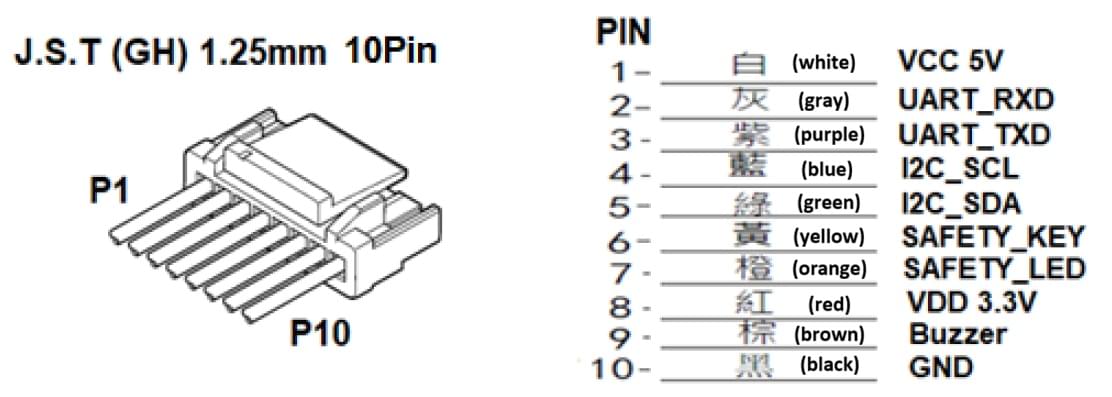
The GlobalSat BD-100K uses UART output via a JST-GH-10P connector. Connect it to the 10-pin GPS1 port (the "Full GPS + Safety Switch Port") on flight controllers that use the Pixhawk Connector Standard. See Pinouts for the pin assignments. The receiver is powered with 5V from the port (pin 1); its UART signals are 2.8V TTL and its I2C signals 3.3V.
PX4 Configuration
PX4 communicates with this receiver using the NMEA protocol (this is not included in firmware for boards with constrained flash). To enable, set GPS_1_PROTOCOL to 6 (NMEA (generic)) and reboot the vehicle. No baud rate setting is needed: PX4 detects the receiver's factory rate of 230400 baud automatically.
To use the receiver as a secondary GPS, set GPS_2_CONFIG to the port it is connected to, and GPS_2_PROTOCOL to 6, and reboot. See Secondary GPS Configuration (UART) for more information.
Set the position of the antenna relative to the vehicle's centre of gravity using SENS_GNSS0_OFFX, SENS_GNSS0_OFFY and SENS_GNSS0_OFFZ.
For RTK setup see RTK GNSS.
LED Meanings
| LED colour | Status indicator | Description |
|---|---|---|
| Red | Safety LED | Safety switch LED indicator. Drives the internal red LED in coordination with safety switch logic. |
| Blue | GNSS LED | GNSS positioning status indicator. |
| R, G, B | System Status LED | Used to indicate various UAV flight and system statuses. Controlled via I2C (address 0x54) using the integrated IS31FL3195 driver. |
Testing
In the QGroundControl MAVLink Console, run gps status to see the protocol, fix type and number of satellites, or listener sensor_gnss to see the published data. For RTK, fix_type is 5 for an RTK float solution and 6 for RTK fixed.